ARTIST STATEMENT
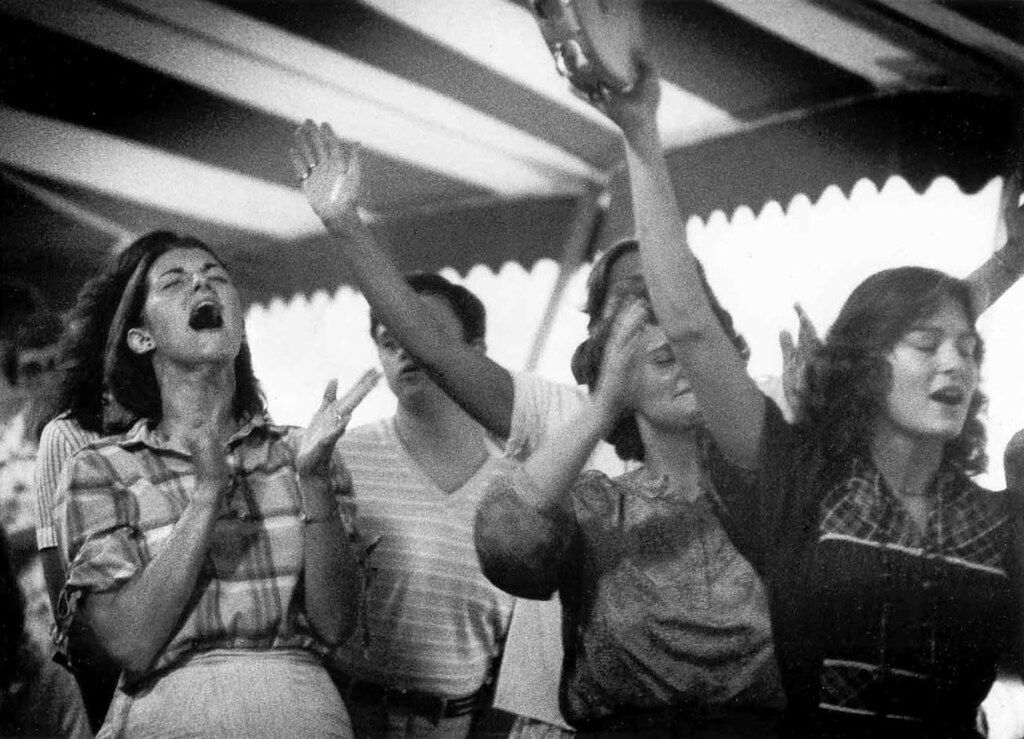
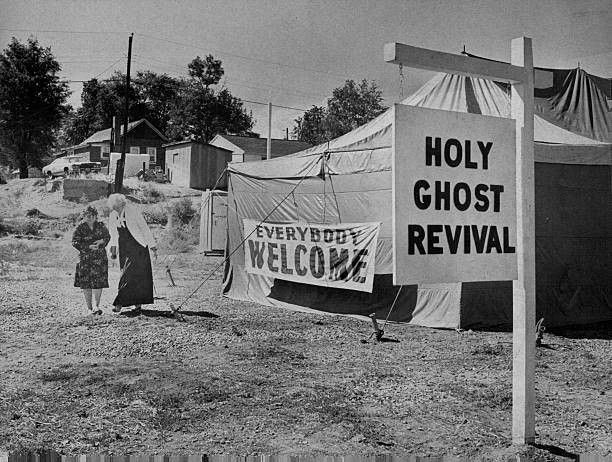
I first heard Aimee’s name at a Revival Meeting, while the sweaty hand of a red-faced man was hammering on my forehead. His eyes were screwed shut. Forehead bulging with pulsating veins. Praying with such comical fervor that I felt he might combust. He, as the voice of God, called out an identity that I didn’t know was within me: that I was to be an Aimee McPherson to the heathen City of Los Angeles.
This is something Charismatics do: project a sense of grandeur onto the person you are praying for through statements delivered as “Prophetic” — the voice of God — often by referencing aspirational figures that God has commanded you to be like.
I’m British. Posh British. I speak with such classic RP that I sound like a wartime radio announcer.
No surprise, then, that the most common Prophetic call bestowed upon me was that I had a QUEEN-ELIZABETH-ANOINTING on my life.
Once, I was told that God had given me THE MANTLE OF PRINCESS DIANA. I didn’t want to think too hard about what kind of heavy burden that might entail. Scary.
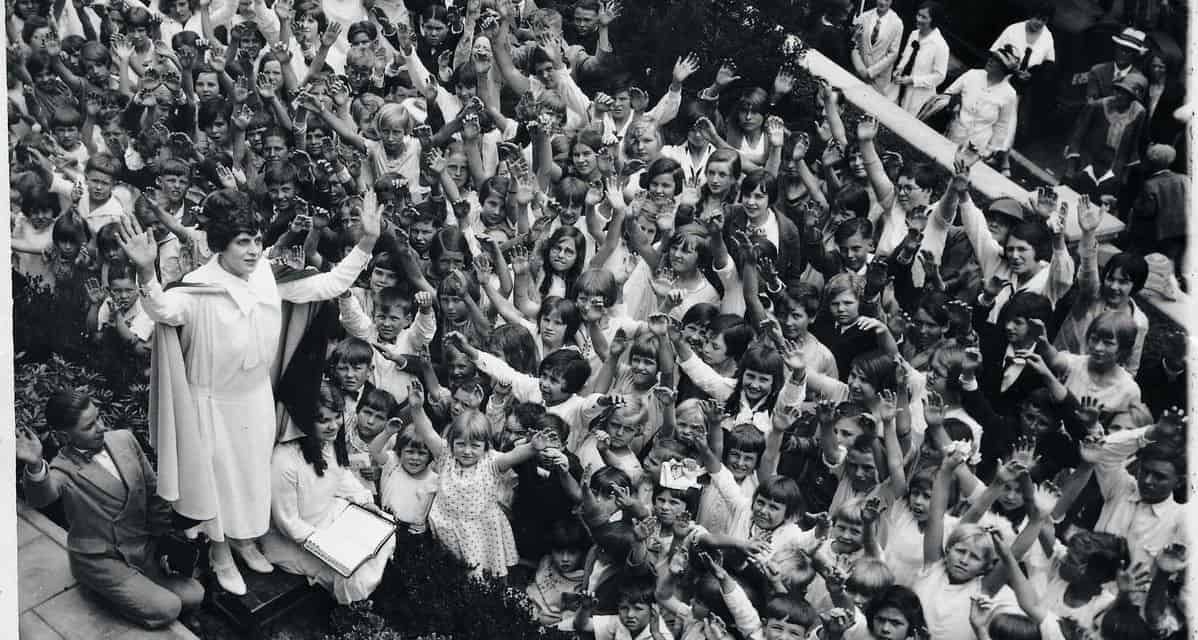
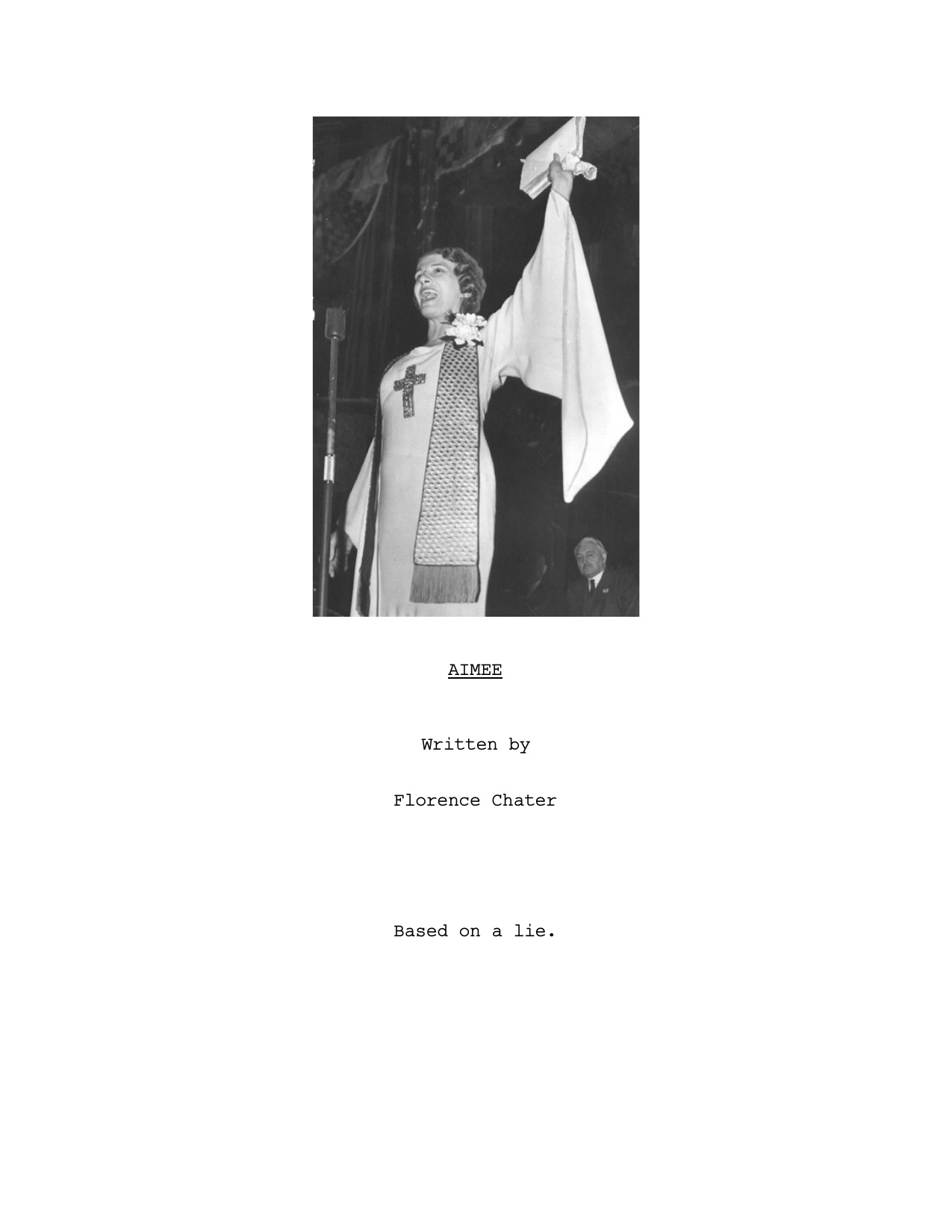
I am also an Angeleno. I’ve lived here for nearly two decades and I care about the city greatly. For this reason, I have had more than my share of prayers and prophetic utterances commissioning me as A NEXT GENERATION AIMEE SEMPLE MCPHERSON.
Perhaps it was here, in the self-assumed comparison, that I first became interested in the life of Aimee.
My Charismatic companions drew this metaphor by way of encouragement. Aimee, in their eyes, was a great and noble faith leader who conquered a city and drew hundreds of thousands of followers.
On reflection, I think it would surprise them that I did indeed come to see similarities between myself and Aimee. Only, not in her strength, but in the cobwebs of her hidden life.
In the places where shame, ego, doubt, and the desire to disappear ate away at her. There, in the unruly restlessness of her yearning for rebellion, I saw a part of her that deeply resonated.
In many ways, I’ve written Aimee as myself.
I walked away from the Charismatic church only a few years ago.
My detangling has ebbed and flowed. Leaving an institution known for systemic methods of control does — no surprise — leave its claws in you. The design itself is calibrated to magnify doubts and questions into sinful divergences, so much so that you simply do not doubt. You simply do not ask questions.
While Aimee explores the doubts in her faith life, it also, and more urgently, explores the doubts she feels within herself. She is paralyzed within a story she has created for herself: both the one onstage and the one in the cellar.
She is a woman who wants to explore sexual liberty and feminist independence, while finding herself all the more entrapped in the dichotomies of virtue versus scandal. Fame versus a life unseen. The extraordinary versus the mundane.
She is plagued by the realization that the psychological battle she has been led her whole life to believe was spiritual might actually just be the warring of her own ego.
As my own faith hung by a mere thread, what I began to realize was that I was no longer practicing religion out of any deep sense of spiritual conviction. I was simply still practicing religion because I was good at practicing religion.
It was a language I knew. There was solace in the spiritual superiority I felt when others looked to me for wisdom or guidance. Their validation was integral to my own identity.
I didn’t know who I was, or how I could operate, outside of this position as young-emerging-preacher-woman that I had seemingly carved out for myself through little more than my public speaking skills.
I didn’t write Aimee to capture a historical figure.
I wrote Aimee as some kind of balm for the wounds of my own torment.
Preachers are naturally good storytellers.
And I liked movies. I always had.
For much of my naive religious life, the only way I felt able to explore impulses of sex, lust, anger, gluttony, or hedonism was through movie characters that I both judged and envied.
I’d worked in film. Briefly, in the indie world. I had been a script doctor as a holiday job in my teenage years, back when I was so prudish that I would chastise any script containing so much as a blowjob for being unnecessarily lustful.
I don’t know how I kept that job.
Then I worked as a publicist at A24, where I refused to work on some of their more provocative titles for fear that the themes would compromise my religion.
I didn’t fall into the deep end until my mid-twenties, when, in some kind of deranged and maddening longing, I found myself within a popular Charismatic community where I lived and worked and loved in a small town in the foothills of Mount Shasta.
I gave my twenties to this place. A place where naivety and virginity were celebrated, alongside bigotry and small-minded thinking.
Aimee is the embodiment of my own search for freedom. My own struggle with a forged identity. My own reckoning with a role that I was good at but no longer fit. My own curiosity about, and desire for, intimacy richer than merely the vapor of the Holy Ghost, which cannot truly hold you.
Aimee is a chance to start again. To find my own words. To be the writer, not just the critic or the marketer.
I wrote it this summer while camper-vanning across America with my partner. It was written as I, too, emerged from my own chrysalis: renouncing what was once true and struggling to fit comfortably within a new understanding of myself.
It has been as much a process of healing as it has a process of discovery.
It was never written with the intention of becoming some thesis on the existence of God, but rather an exploration of the external forces that govern, limit, or compel the ways in which we see ourselves.
And, finally, it has been my journey back to trusting myself.